‘Films Can Open Minds and Encourage Dialogue’: Fatherland Producer at IFFI

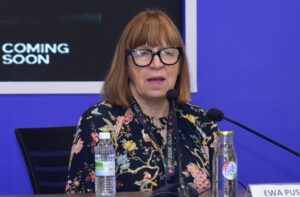
Panaji: Cinema can open minds, encourage dialogue and help people understand different perspectives, even if films cannot change the world overnight, Polish producer Ewa Puszczyńska said at the 57th International Film Festival of India (IFFI).
Speaking at a press conference, Puszczyńska, producer of the festival’s opening film Fatherland, said growing divisions in society made dialogue more important. She urged people to listen to different viewpoints and find common ground rather than remain confined to their own narratives.
Set in divided Europe in 1949, Fatherland explores the East-West divide, identity, migration and belonging through the story of German writer Thomas Mann and his family. The film also examines family relationships, the influence of culture and the expectations faced by children of celebrated artists.
Puszczyńska said the film was shot in black and white and in a 4:3 aspect ratio to recreate the period’s visual authenticity. She described it as potentially the third film in her collaboration with director Paweł Pawlikowski, following Ida and Cold War.
The international co-production involves Poland, Germany, Italy and France. Although set in Germany, nearly 95% of the film was shot in Poland, where locations were selected to recreate the appearance of Germany in 1949.
Puszczyńska also expressed interest in making a film on the shared history of India and Poland, particularly about Polish children who found refuge in India during the Second World War. She said she hoped to take the idea forward following discussions with IFFI Festival Director Ashutosh Gowariker, who has already written a script on the subject.