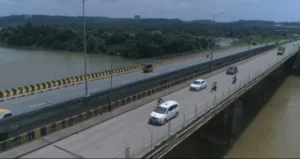
NHAI issues new guidelines for access-controlled high-speed highways

New Delhi: The National Highways Authority of India (NHAI) has introduced comprehensive guidelines for planning and designing access-controlled high-speed National Highways, excluding Expressways, aimed at standardising technical specifications, improving road safety and enabling smoother traffic movement.
The guidelines will apply to upcoming four- and six-lane Greenfield and Brownfield high-speed access-controlled National Highways. They seek to bring greater uniformity to the preparation of Detailed Project Reports (DPRs) and ensure consistency in design and safety standards across the highway network.
The move is part of the government’s long-term roadmap under Viksit Bharat 2047, which envisages developing 50,000 km of access-controlled high-speed corridors to improve connectivity and reduce logistics costs.
NHAI said there were currently no separate standards governing the planning and design of access-controlled high-speed National Highways other than Expressways. Variations in technical standards adopted while preparing DPRs had highlighted the need for a common framework.
Standardised lane and corridor design
Under the new framework, lane configurations will be determined based on projected traffic volumes.
For corridors carrying up to 15,000 vehicles, a four-lane highway with four-lane structures will have a proposed width of 60 metres. Corridors with traffic between 15,000 and 25,000 vehicles will have a 70-metre width with a four-lane highway and six-lane structures.
For traffic volumes between 25,000 and 40,000 vehicles, the proposed configuration will be a six-lane highway with six-lane structures and a 70-metre corridor width.
Interchanges at key locations
The guidelines provide for ramp-based interchanges at crossings with Expressways, National Highways, State Highways and major arterial roads carrying substantial traffic.
Interchanges will also facilitate access to major traffic-generating destinations, including ports, airports, Multi-Modal Logistics Parks (MMLPs), industrial areas and major tourist destinations.
Additional safety provisions have been included for high-speed traffic, including advance notification of entry and exit points to help motorists anticipate upcoming access and egress locations.
To strengthen access control and prevent encroachments, unauthorised entry and stray cattle from entering high-speed corridors, the guidelines prescribe a one-metre-high boundary wall along the outer edge of the corridor.
NHAI said the framework is intended to standardise the planning and design of fully access-controlled National Highways while improving safety, operational efficiency and seamless movement across the network.